





HRV and Exercise
Exercise is the single most effective way to raise your baseline HRV over time. It is also, on any given day, the thing most likely to suppress it. Understanding this paradox is the key to using HRV data to train smarter.
The Training Paradox
A hard training session suppresses HRV. Your sympathetic nervous system activates during exercise, heart rate rises, the vagal brake releases, and beat-to-beat variability drops. In the hours after a demanding session, HRV typically remains below your baseline as your body works to recover — repairing muscle tissue, clearing metabolic waste, replenishing glycogen stores.
Yet over weeks and months of consistent training, baseline HRV rises. Regular aerobic exercise strengthens the heart, improves baroreflex sensitivity, and enhances parasympathetic tone. Well-trained endurance athletes typically have resting HRV values far above population averages for their age. A 40-year-old cyclist might have an RMSSD of 80ms where the population median is around 50ms.
The paradox resolves when you consider the timescale. Each session temporarily stresses the system. But if recovery is adequate, the body adapts by strengthening the parasympathetic response. HRV rises. If recovery is not adequate — if the next hard session arrives before the previous one is absorbed — the system accumulates fatigue instead of adaptation. HRV trends downward.
HRV-Guided Training
The practical application of HRV in training is straightforward: use your morning RMSSD to decide whether today should be a hard day or a recovery day.
Research by Daniel Plews and colleagues demonstrated that HRV-guided training — where athletes trained hard only when their HRV was at or above baseline, and trained easy when it was suppressed — produced equivalent or better performance gains compared to fixed training plans, with less total training stress. The body was directing its own programme, and doing it better than the calendar.
How to read your morning HRV for training decisions
Establish your personal baseline by tracking your morning RMSSD for at least two weeks. Calculate your 7-day rolling average and your normal range (the band your readings typically fall within).
HRV at or above your rolling average: your body has absorbed recent training load. You can train hard today.
HRV below your rolling average but within normal range: some residual fatigue. Moderate training is appropriate. Listen to how you feel during the warm-up.
HRV significantly below your normal range: incomplete recovery. Scale back to easy aerobic work, mobility, or rest. Pushing through will likely dig the hole deeper.
HRV trending downward over several days: accumulating fatigue or other stress. Consider a deload period regardless of how you feel. Subjective feelings often lag behind what HRV reveals.
Overtraining and the HRV Signal
Overtraining syndrome is notoriously difficult to diagnose because its symptoms — fatigue, poor performance, mood disturbances, disrupted sleep — overlap with many other conditions. HRV provides one of the earliest objective markers.
In the early stages of overreaching (functional overreaching), HRV typically shows increased day-to-day variability — wider swings than normal, with some unusually high readings mixed with low ones. This instability in the HRV signal often precedes performance decrements and subjective fatigue.
In established non-functional overreaching or overtraining, the pattern shifts to a sustained suppression of HRV below normal range, often accompanied by a paradoxically elevated resting heart rate. Recovery from this state can take weeks to months. The HRV data, had it been heeded earlier, would have shown the warning signs days or weeks before the athlete hit the wall.
Recovery and the Vagal Rebound
After exercise, HRV recovers in two phases. The immediate post-exercise period (first 30-60 minutes) sees a rapid partial rebound as acute sympathetic activation subsides. The second phase — full recovery to baseline — can take anywhere from a few hours after easy training to 48-72 hours after a demanding session.
The speed of this recovery is itself a fitness marker. Fitter individuals show faster HRV recovery after exercise. This is why heart rate recovery (how quickly your pulse drops after stopping exercise) is closely related to HRV — both reflect the efficiency of the vagal brake re-engaging.
Accelerating recovery with tVNS
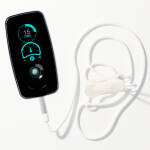
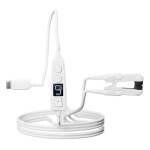
Vagus nerve stimulation after exercise offers a direct way to support parasympathetic reactivation during the recovery window. By stimulating the auricular branch of the vagus nerve, tVNS promotes the vagal rebound that active recovery and rest depend on. Our Recovery Tone protocol is specifically designed for post-exercise use, targeting the parasympathetic shift that allows adaptation to occur.