




How to Improve Your HRV
Heart rate variability responds to intervention. Whether your HRV is lower than you'd like or you want to push it higher, there are proven ways to shift it, some within minutes, others over weeks. This guide covers every evidence-based method, from the habits that build the foundation to the technology that targets the mechanism directly.
Every intervention listed here works through the same pathway: strengthening vagal tone, the activity of the vagus nerve that regulates your heart rhythm beat by beat. Higher vagal tone means higher HRV. The question is how to get there.
The Foundations
These are the lifestyle factors that set your baseline. Without these in place, no supplement, gadget, or technique will move HRV meaningfully. They are boring, they are well-known, and they work.
Exercise Consistently
Strong evidenceRegular aerobic exercise is the single most robust intervention for raising baseline HRV over time. It strengthens the heart, improves baroreflex sensitivity, and enhances parasympathetic tone. Well-trained endurance athletes routinely show RMSSD values 40-60% above population averages for their age.
The paradox is that each hard session temporarily suppresses HRV. Your body adapts during recovery, not during exertion. Overtraining (pushing through without adequate recovery) drives HRV down instead of up. This is why HRV-guided training, where you train hard when your morning RMSSD is at or above baseline and back off when it's suppressed, produces better results than following a rigid plan.
Prioritise Sleep
Strong evidenceSleep is when your parasympathetic nervous system does its deepest work. HRV typically peaks during slow-wave sleep in the first half of the night, when the vagus nerve exerts its strongest cardiac regulation. Sleep deprivation, fragmented sleep, or poor sleep quality all directly suppress HRV, often before you feel tired.
Alcohol is the single biggest modifiable sleep-HRV disruptor. Even two drinks can reduce overnight HRV by around 30%, and the effect lingers for 24-48 hours. Late eating, screen exposure, and inconsistent sleep timing all degrade the parasympathetic dominance that healthy sleep depends on.
Manage Chronic Stress
Strong evidenceChronic stress keeps the sympathetic nervous system elevated and prevents the vagal brake from re-engaging. Over weeks and months, this drives baseline HRV steadily downward. The insidious part is that people often adapt to chronic stress cognitively (you stop feeling stressed) while the autonomic impact continues to accumulate. Your HRV trend will show the strain before you feel it.
The mechanism is well understood. Stephen Porges described the vagus nerve as a "vagal brake": engaged when you feel safe, released under threat. Chronic stress keeps the brake off. The goal of any stress intervention is to re-engage it.
Active Interventions
These are the things you can do deliberately to shift your autonomic balance toward parasympathetic dominance. Unlike the foundations, which set conditions, these directly stimulate vagal activity.
Slow Breathing
Strong evidenceBreathing at approximately 6 breaths per minute (5 seconds in, 5 seconds out) produces a state called cardiac coherence, where heart rate oscillations synchronise with the breathing cycle and the baroreflex. This directly stimulates the vagus nerve and can produce a measurable RMSSD increase within minutes. It is the most immediate HRV intervention available and costs nothing.
The mechanism is respiratory sinus arrhythmia. During exhalation, vagal output increases and heart rate drops. During inhalation, it decreases and heart rate rises. Slowing the breath amplifies this oscillation. Extended exhale patterns (4 seconds in, 6 seconds out) bias the cycle further toward parasympathetic dominance.
HRV biofeedback formalises this into a structured practice. Clinical trials show that 10-20 minutes of resonance frequency breathing, practised daily for 8-10 weeks, produces lasting improvements in resting HRV even outside of practice sessions. The effect builds over time as the baroreflex strengthens.
Vagus Nerve Stimulation
Growing evidenceEvery other intervention on this page works indirectly. Exercise improves cardiovascular fitness, which raises vagal tone. Sleep provides conditions for parasympathetic recovery. Breathing stimulates the vagus through the baroreflex arc. Vagus nerve stimulation is the only method that activates the vagus nerve directly.
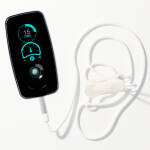
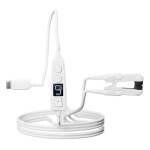
Transcutaneous auricular vagus nerve stimulation (taVNS) delivers mild electrical pulses to the auricular branch of the vagus nerve in the ear. The afferent signal travels to the nucleus tractus solitarius in the brainstem, the same integration centre that processes baroreflex input from breathing and blood pressure regulation. From there, it modulates parasympathetic outflow to the heart.
The published evidence on taVNS and HRV is building. A number of studies have shown acute improvements in HRV metrics during and after stimulation sessions. A 2023 meta-analysis of 12 RCTs involving 838 participants found that taVNS produced significant improvements in depression scores, with the mechanism linked to restored autonomic balance. Separately, studies on baroreflex sensitivity (the responsiveness of the system that the vagal brake depends on) have shown improvement with taVNS.
What makes tVNS unique as an HRV intervention is consistency and dose control. Breathing exercises require focus and practice. Exercise requires recovery time. tVNS delivers a controlled, repeatable dose of vagal activation in a session you can do while reading, watching television, or preparing for bed. It stacks with every other intervention on this page: using tVNS during slow breathing, or after exercise during the recovery window, targets the vagus nerve through complementary pathways simultaneously.
We are currently running an HRV study measuring RMSSD, SDNN, pNN50, and Poincare metrics in real time during vagus nerve stimulation sessions. The study uses the Polar H10 chest strap for research-grade ECG accuracy and compares HRV before, during, and after stimulation. This is the kind of data that no consumer wearable company produces, because none of them make a device that directly targets the mechanism.
Cold Exposure
Moderate evidenceCold water immersion and cold showers activate the dive reflex, which triggers a strong vagal response: heart rate drops, peripheral blood vessels constrict, and parasympathetic activity surges. Research shows that cold water face immersion in particular produces an acute HRV increase. Regular cold exposure may improve vagal tone over time, though the evidence for chronic adaptation is less robust than for exercise or breathing.
Diet and Alcohol
Moderate evidenceA Mediterranean-style diet rich in omega-3 fatty acids, polyphenols, and leafy greens has been associated with higher HRV in several observational studies. Omega-3 supplementation (from fish oil or algae) has shown modest but consistent HRV improvements in controlled trials, likely through anti-inflammatory effects on vagal pathways.
Alcohol, however, is by far the biggest dietary factor. Two drinks can suppress overnight HRV by approximately 30%, and the effect persists for up to 48 hours. Many people first discover the power of HRV tracking by seeing the unmistakable dip after a night of drinking. Reducing alcohol is one of the simplest, most immediately visible ways to raise your baseline.
How Long Does It Take?
HRV improvement is not instant. Some interventions produce acute effects within minutes; lasting baseline shifts take weeks to months of consistency. Here is a realistic timeline.
The compounding effect
These interventions are not alternatives. They stack. Regular exercise sets the cardiovascular foundation. Good sleep provides the recovery conditions. Slow breathing trains the baroreflex. Vagus nerve stimulation activates the pathway directly. Each one makes the others more effective. A person who exercises, sleeps well, breathes deliberately, and uses tVNS daily is targeting their vagal tone from four directions simultaneously. The cumulative effect over months is substantially greater than any single intervention alone.
What Doesn't Work
Not everything marketed for HRV improvement has evidence behind it. A few common claims that don't hold up well under scrutiny.
Supplements beyond omega-3s: magnesium, ashwagandha, and various adaptogens are frequently cited for HRV improvement. The evidence is thin, inconsistent, or based on single small studies. Omega-3s have reasonable support. Most other supplements do not.
Single-session thinking: a great meditation session or a cold plunge will produce an acute HRV bump. But isolated efforts without consistency do not shift baseline HRV. The body adapts to sustained, repeated signals, not one-offs.
Obsessing over daily readings: checking HRV every morning and reacting to each individual data point creates anxiety that itself suppresses HRV. Track the 7-day rolling average. That is where the information lives. A single low reading after a bad night's sleep tells you nothing you didn't already know.
Your HRV responds to what you do
Start with the foundations, add the active interventions, and give it time. If you want to target the vagus nerve directly, our devices are designed to do exactly that, and you can see the expected impact on your HRV age with our free calculator.
Find your device HRV calculator