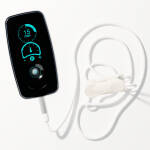
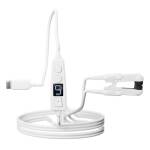
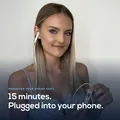
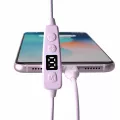
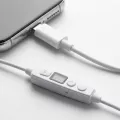
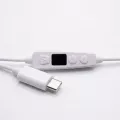
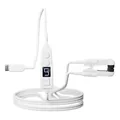
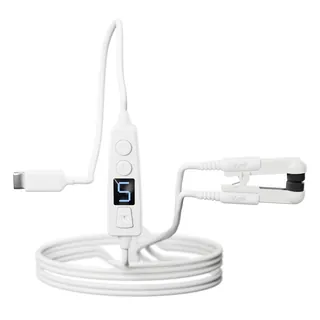
A small ear clip that runs from your phone. Plug it in, clip it on and run a 15-minute session. Nothing to charge and no app to set up. People use it to wind down in the evening or take a quiet break in the day.
One-time purchase · 45-day money back · HSA/FSA eligible · No subscription

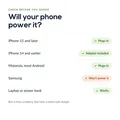
Check your phone firstBoost has no battery. It runs from whatever it plugs into.
iPhone and most Android phones work. Samsung phones do not.
What $59 gets you
In stock · Free shipping
45 days to decideLike Buddy and Oh!, Boost comes with our 45-day money-back guarantee. If it is not for you, email us within 45 days of delivery and send it back for a full refund. Return postage is yours, about $20 from the US, and returns go to our UK facility. How it works. A 2-year warranty covers faults.
Which Vagal is this?
Plugs into a phone, laptop or power bank. Buttons on the unit.
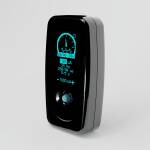
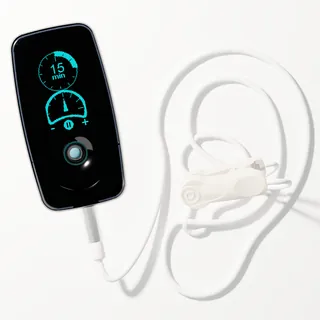
Handheld, with a screen and its own battery.
Wireless. Sits on the ear and runs from an app.
Not with a pacemaker or other implant, or in pregnancy. Who should not use Boost
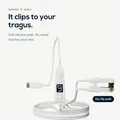
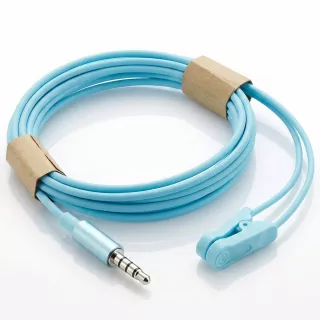
The clip goes on the tragus, the small flap in front of your ear canal, where a branch of the vagus nerve reaches the skin. A session is fifteen minutes.
What it feels likeMost people feel a mild tingle, and some feel very little. Comfortable is the target, not strong.
What is normalEvery mode except A changes rate during the session, with a short pause at each change. Changing mode yourself resets the level to zero, so press + again. A mild tingle along the jaw or neck can be normal at first; if anything feels sharp or painful, stop.
How oftenOnce a day. Give it four to six weeks before you decide whether it is doing anything for you.
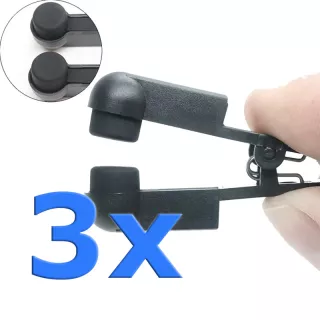
What touches your skinOnly the conductive silicone pads, which are latex-free. No metal touches your skin.
For adults 18 and over. Never on broken or irritated skin. Not while driving or using machinery, in the bath, shower or pool, or near oxygen or flammable liquids. Power it from a battery (your phone, a laptop or a power bank), never a mains wall charger. If you feel faint or unwell during or after a session, stop, take the clip off and see your doctor.
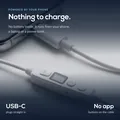
The Boost has no battery -- it draws its power from whatever you plug it into. That is what keeps it so small, and it means your phone has to be willing to send power out of its port. Most do. Samsung phones do not.
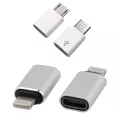
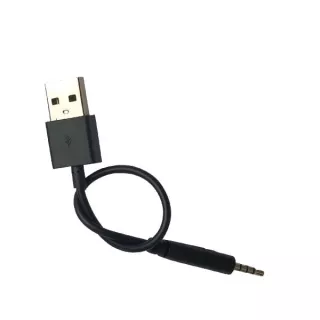
Plug straight into the USB-C port. Full intensity range, no adapter needed.
Use the Lightning adapter included in the box, then follow the startup sequence as normal.
Samsung handsets do not supply power to the Boost, across the whole range. No setting fixes it. Run it from a laptop or power bank instead.
Motorola handsets are confirmed working. Most others plug straight into the USB-C port -- if yours does not, tell us the model and we will add it here.
Power it from a battery. Your phone, a laptop, or a USB power bank all work. Please do not run the Boost from a mains wall charger -- it is designed to be battery powered. If your phone will not power it, a small power bank keeps the whole thing pocket-sized.
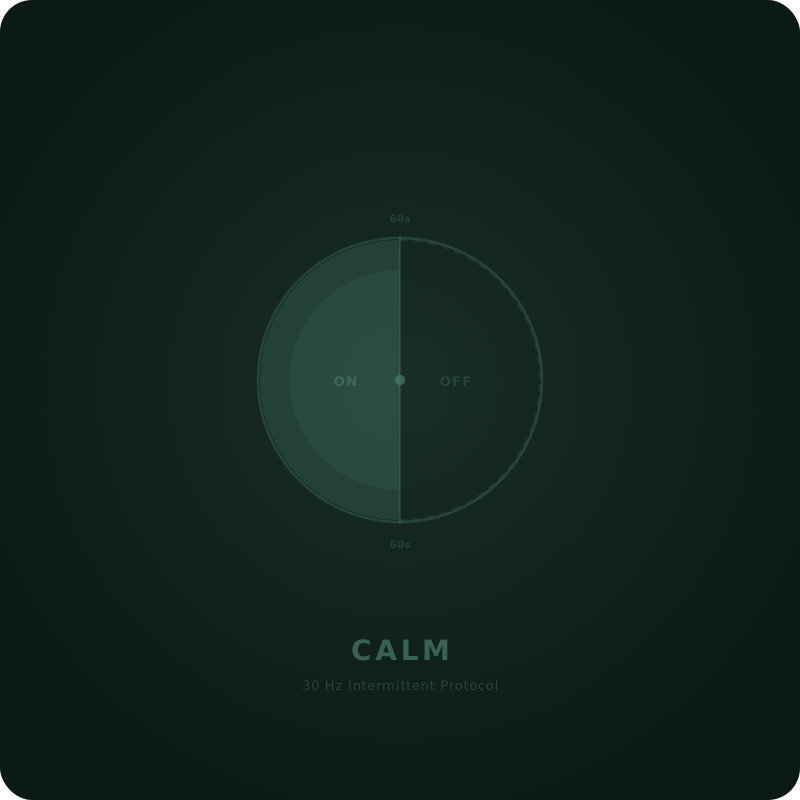
Each program is a different pattern of pulse rates, between 3 and 78 pulses a second, all with the same 275 microsecond pulse and the same nine levels. Pick the one that feels comfortable. There is no app and nothing to set up.
One rate from start to finish.
Steps down through three rates.
The gentlest feel. Start here.
A higher and a middle rate, taking turns.
Two higher rates, taking turns.
The whole range in one session.
The program names are labels, not promises of a particular effect. Boost does not run Vagal Tones, the programs used on Buddy and Oh!.
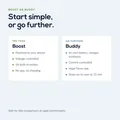
All three stimulate the same branch of the vagus nerve at the ear, for 15 minutes a session. Boost is the simplest and cheapest way to find out what that feels like. This is what the other two add.
Boost holds the voltage steady. As your skin and the paste settle during a session, the current that reaches your skin can rise or fall, so the tingle can get stronger or fainter. You bring it back with + and -. Buddy and Oh! keep adjusting to hold the current where you set it, so you set it once.
It is simpler inside: no battery, no wireless chip and no circuit holding the current steady. It borrows power from your phone instead. Boost suits you if you want to find out what ear stimulation feels like for the least money and do not mind adjusting the level by hand.
Boost is sold in the US and UK only. Will Boost work with my phone?
University teams have studied stimulation at the tragus, the spot the Boost clip sits on, for more than a decade. These are three of the studies behind the method. They used research stimulators with their own settings, mostly with healthy adults, so none of them tested Boost itself.
48 healthy adults. Measured heart rate variability and the activity of the nerves behind the fight-or-flight response during ear stimulation, against a sham group.
Read the studyA randomised, placebo-controlled trial in 13 healthy young men, with tragus stimulation compared against two shams. Measured heart rate variability and the reflex that steadies blood pressure.
Read the studyAdults aged 55 and over, fifteen minutes a day at the tragus for two weeks. Measured autonomic balance, mood and sleep. That part of the study had no comparison group.
Read the studyResearch results are averages from study groups, not a promise for any one person. More studies, and what is still unknown, on The Science.
Not in the box: a power bank. You only need one if your phone will not power the Boost. Replacement clips and paste are sold separately.
This device is a fantastic investment. It’s affordable, easy to use, and really effective. I’ve been using it to help with my anxiety and digestion issues, and it’s made a noticeable difference. I love that it’s powered by my phone. It’s so convenient and portable. I would definitely recommend it to anyone looking for an affordable solution.
This little device is amazing! It’s so easy to use, and I love that I can power it with my phone. I’ve been using it to help with my anxiety, and it’s been incredibly effective. It’s also great for relieving tension headaches. For the price, it’s an absolute steal. I’m so glad I gave it a try!
I’ve been struggling with stress and mild insomnia, and this vagus nerve stimulator has been a lifesaver. It’s non-invasive and so easy to use. I just plug it into my phone, and within minutes, I feel a sense of calm. It’s become part of my nightly routine, and I’m sleeping much better now. I’m really impressed with how well it works for such an affordable price.
I didn’t expect much from such an inexpensive device, but I was wrong. This vagus nerve stimulator has helped me manage my migraines better than anything else I’ve tried. It’s gentle, non-invasive, and the fact that it’s powered by my phone is a huge bonus. I use it daily, and it’s made a noticeable difference in my quality of life. Highly recommend!
Straight answers to the questions people ask before they buy.
Vagal devices are sold online only, and the best place to buy is direct from vagal.com. Every Vagal Boost bought there comes with our 45-day money-back guarantee, a 2-year warranty and support from the team that makes it, the same as Vagal Buddy and Oh!.
Vagal Boost costs $59 (usually $159, US and UK only). For comparison, Vagal Buddy is $349 (usually $399) and Vagal Oh! is $249 (usually $499). Each is a one-time purchase with no subscription, and prices show in US dollars, pounds or euros depending on where you are.
Vagal Boost is our lowest-cost device. It plugs into most phones (not Samsung) and uses voltage-controlled stimulation. It is sold in the US and UK; elsewhere the most affordable option is Vagal Oh! at $249 (usually $499), which is current-controlled. In the US, paying with HSA or FSA funds lowers the real cost further.
All major credit and debit cards, PayPal, Apple Pay and Google Pay. In the US you can also pay with an HSA or FSA card: how to use HSA and FSA funds.
We ship to most countries, and people in more than 40 countries use Vagal. Shipping is free to the US, UK, Canada and Australia, and a flat delivery charge shown at checkout applies elsewhere. US orders ship from Reno, Nevada, and orders placed before 1pm Pacific on working days usually ship the same day.
No. Every Vagal device is sold new, with our full warranty. We do not sell refurbished, used or returned units.
What matters is whether your phone will send power out of its port.
iPhone: works. iPhone 15 and later plug straight into the USB-C port. iPhone 14 and earlier use the Lightning adapter included in the box.
Samsung phones: these do not work. We would rather tell you now than have you find out after ordering. Samsung handsets do not supply power out of their USB-C port to the Boost, and we have seen this right across the range, from the older A-series and S-series up to the current models and the Flip. It is not a fault in the device and there is no setting that fixes it.
Other Android phones: Motorola handsets are confirmed working, and most others plug straight into the USB-C port. If yours does not, tell us the model and we will add it here.
If your phone will not power it, the Boost runs from a laptop USB-C port or a USB power bank. A small power bank keeps it properly portable.
One thing to avoid: do not run the Boost from a mains wall charger. It is designed to be powered from a battery: your phone, a laptop, or a power bank.
Short answer: no, and if you have a Samsung there is unfortunately no setting that will help.
Samsung phones do not power the Boost. We have seen this consistently across the range: A-series, S-series, Ultra models, the Flip, and Samsung tablets. Samsung handsets do not send power out of their USB-C port to this device. Older guidance suggested enabling a "USB OTG" option in settings; on modern Samsungs that setting does not exist, and on the ones where it does, it makes no difference. If you have gone looking for it and could not find it, nothing is wrong with your phone.
You have not done anything wrong and your Boost is not faulty. Run it from a laptop USB-C port or a USB power bank instead and it will work normally. If you would rather return it, get in touch and we will sort that out without any fuss.
Other Android phones are generally fine plugged straight in. On some older models it is worth checking your settings for a USB OTG or USB power output option and switching it on.
Whichever route you take, do not power the Boost from a mains wall charger. It is meant to run from a battery: your phone, a laptop, or a power bank.
No. Please power it from a battery instead: your phone, a laptop, or a USB power bank.
A mains wall charger will appear to work, and some customers have found this out for themselves, which is why we want to be explicit rather than silent about it. The Boost is designed to run from battery power and that is how it should be used.
If your phone will not power the Boost (which is the case with Samsung handsets), a laptop USB-C port or a small USB power bank is the right answer. A power bank also keeps the setup properly portable, which is rather the point of the device.
It varies. Some people feel calmer during their first session, and some notice very little at first. Use it once a day for four to six weeks before you decide whether it is doing anything for you.
The tragus studies we cite ran from a single session to two weeks of daily use, on research stimulators, so they cannot tell you what you will notice with Boost.
The only parts that touch your skin are the conductive silicone pads. No metal touches your skin, and silicone is naturally latex-free.
The material is a deliberate choice, not a cost saving: conductive silicone’s higher impedance is part of what keeps tENS stimulation gentle and safe, and it is also why lightly dampening the pads before a session makes the sensation smoother.
Boost uses a uniphasic square wave with a 275 microsecond pulse, at 3 to 78 Hz across its six modes, with nine intensity levels. Uniphasic means each pulse flows in one direction only. Boost's pulses are not charge-balanced: there is no opposite pulse to cancel each one. Buddy and Oh! use biphasic pulses instead.
Boost is voltage-controlled. It holds the voltage steady, so the current that reaches your skin can rise or fall as your skin and the paste settle during a session. If the tingle changes, adjust it with + and -.
The only parts that touch your skin are the conductive silicone pads. The lead connects to the clip with two 2 mm stainless steel pins, which sit inside the clip.
Boost is CE marked and FCC Part 15 certified, with a Type BF applied part (body-floating protection against electric shock). Wipe the pads after each session, and stop using Boost if the skin where the clip sits stays irritated. Setup steps are in the Boost instructions.
Vagal Boost is a wellness device, not a medical treatment. It's designed to support your parasympathetic nervous system alongside healthy habits. It is not intended to diagnose, treat, cure, or prevent any disease. If you have a specific medical condition, consult your doctor about whether vagus nerve stimulation might complement your treatment plan.
No. It's a one-time purchase. The device works out of the box with no ongoing costs. Optional replacement ear clips and conductive paste are available from our store when you need them.
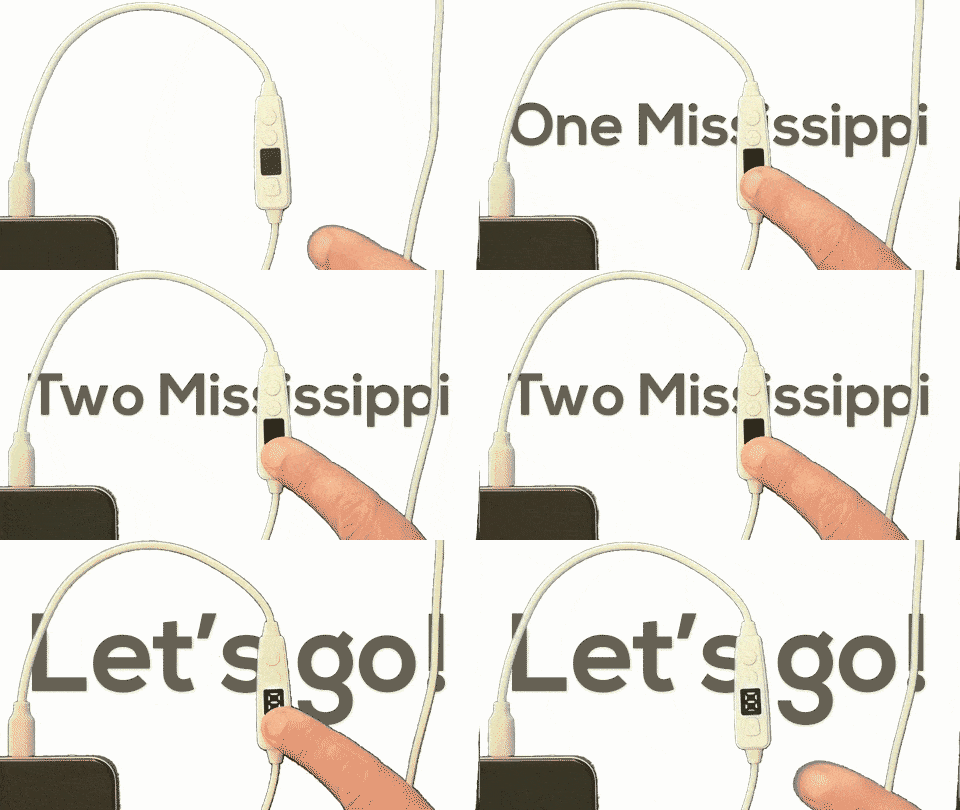
Press and hold the M button for about two seconds, until the screen lights up.
A quick tap will not do it. The press has to be held. If your screen is dark, this is the first thing to try. Hold it long enough to say one Mississippi, two Mississippi, and the display comes on.

The Boost has no battery, so it needs to be plugged into your phone, a laptop, or a USB power bank to work. If the screen still stays dark after a proper long press, the port is probably not supplying power rather than the device being faulty. See the separate question on what to check.
Two different things can look like this, and it is worth telling us which one you are seeing.
If it switches off about thirty seconds after turning on, the intensity was probably never set. After you hold M to switch on and choose a mode, you must press + to bring the intensity to at least 1, or the device shuts itself off. The same applies every time you change mode: changing mode resets the intensity to zero, so press + again after each switch. This catches most people out at least once.
If it runs and then drops to zero, first check whether M was pressed, even by accident when you put it down: a short press changes the mode, which resets the intensity to zero. If M was not pressed and it still drops to zero, either as you raise the intensity or after a few minutes at a steady level, please get in touch and tell us the exact point it happens: what level it was on, roughly how long it ran, and what it was plugged into. We are gathering these details to get to the bottom of it, and a precise report from you is genuinely more useful than a general one.
Meanwhile, a gentle, comfortable tingle is the target rather than a strong sensation, and the lower settings are where most people find their result. The full steps are in the Boost instructions.
Two things to rule out first, in this order.
1. Have you pressed and held the M button? If the screen is dark, press and hold M for about two seconds. A quick tap will not do it, and it is an easy step to miss. See How do I turn the Boost on? for what that looks like.
2. If you have a Samsung, that is the answer. Samsung phones do not power the Boost. See the separate question above, and use a laptop USB-C port or a USB power bank instead.
The Boost has no battery. It takes its power from whatever it is plugged into. So once you have ruled out the long press, a dark screen almost always means the port is not supplying power, rather than the device being dead.
Two other things worth ruling out: keep your phone above about 20 percent charge, because below that most phones stop powering accessories entirely; and push the connector fully home, taking a thick case off if it gets in the way and checking the port for pocket lint.
If you have given it a proper two-second press on a laptop or a power bank and the screen is still dark, contact us and we will sort it out.
Please do not use a mains wall charger to power the Boost, even to test it. It is designed to run from battery power: your phone, a laptop, or a power bank.
Yes, more than you would expect.
When a phone runs low, it starts protecting its own battery and reduces or stops the power it sends to accessories. On iPhone this typically happens below around 20 percent. The Boost may then refuse to start, or cut out partway through a session.
For a reliable session, start with your phone above 20 percent. If it is running low, use a laptop USB-C port or a USB power bank for that session instead. Never a mains wall charger: the Boost is designed to run from battery power.
A session uses very little of your phone's battery, so this is about having enough in reserve rather than the Boost draining your phone.
Check your phone, clip it on, and give it fifteen minutes a day for four to six weeks.
One-time purchase, HSA/FSA eligible, free US shipping from Reno, NV. Like Buddy and Oh!, it comes with the 45-day money-back guarantee and a 2-year warranty.
Vagal Boost is a wellness device, not a medical treatment. It is not intended to diagnose, treat, cure or prevent any disease. If you are being treated for a condition, talk to whoever is treating you before you start.