



The Vagus Nerve / How tVNS works
How tVNS works: what happens in your tragus
Follow a single pulse from the Vagal Oh! clip, through the skin and cartilage of your tragus, to the nerve endings that feel it. Scroll and the model follows you.
Step 1: The clip
Your tragus
This is your tragus: the small flap of ear in front of your ear canal. It is where the clip sits, and where every pulse goes.
Keep scrolling and the model will follow. Drag sideways on it to turn it.
Step 1: The clip
A branch of the vagus nerve
The yellow line is the auricular branch of the vagus nerve, drawn as if you could see through the skin. In many people it reaches the skin on the ear-canal side of the tragus, as well as the hollow of the ear.
Step 1: The clip
The clip
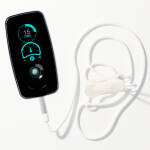
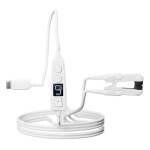
The clip grips the tragus from both sides. Its round body sits on the outside and a slim arm reaches just inside the ear canal, so there is a pad on each side. The nerve runs underneath.
Step 2: The slice
Slice through the tragus
Now cut across the ear at the level of the pads and lift the top away, so you can look down on the cut. Scroll slowly to watch it happen.
Step 2: The slice
Inside the tragus
Between the two pads are skin, a thin layer of fat and a plate of cartilage. A little gel fills the gap between each pad and the skin.
Step 2: The slice
Nerve fibres in the skin
The yellow dots are vagus nerve fibres in the skin facing the ear canal. The grey dots are other skin nerves on the outer side. Nerve supply varies from person to person.
Step 3: The pulse
The pulse
Each pulse pushes a tiny current in through one pad, across the tragus and out through the other, then straight back the other way, so no charge is left behind. Most of it crosses straight between the pads.
Step 4: The tingle
The tingle
The current does not travel along the nerve. It nudges the nerve endings in the skin under the pads, and when the nudge is big enough an ending fires. That is the tingle you feel.
In many people some of the endings on the ear-canal side belong to the vagus nerve, which carries their signals back towards the brainstem. Turn the strength up and more endings join in.
Step 5: The skin
Why the skin matters
Most of the push is needed just to get through the thin outer layer of the skin. Dry skin resists far more than skin with gel on it, so the device has to raise its voltage to keep the current the same. If it reaches its limit, the current falls short and fewer endings fire.
About this model: the ear is stylised and the clip is built from its CAD model. The nerve course is simplified from dissection studies, and nerve supply varies between people. The current in the cut comes from the same model as our tragus current-flow simulator (250 microseconds per phase, 25 pulses a second, and the 60 V limit of our stimulators); which endings fire is illustrative. How much current crosses straight between the pads depends on the shape of the tragus: about 80% in this ear, whose tragus joins the cheek along a broad base, and about 95% in the simpler tragus of the research simulator. For placing the clip, see the ear electrode placement guide. This is an illustration, not medical advice.