





For a long time, heart rate and blood pressure were the standard measures of circulatory health. Lower numbers generally meant a healthier heart and healthier arteries. But researchers have identified another measure that tells us something different -- and in many ways, something more useful.
It's called heart rate variability (HRV), and it measures how much the timing between consecutive heartbeats varies. It turns out that a healthy heart doesn't beat like a metronome. It speeds up and slows down constantly, responding to breathing, movement, stress, and recovery -- beat by beat, in real time.
HRV is increasingly used as a long-term marker of overall wellbeing. Higher HRV is generally associated with better fitness, better recovery, and a nervous system that adapts well to changing demands. Lower HRV tends to reflect a system under strain -- whether from poor sleep, chronic stress, sedentary habits, or simply ageing [1].
What exactly is HRV?
Your heart doesn't beat at perfectly even intervals. Even at rest, the gap between one beat and the next fluctuates by milliseconds. As you breathe in, your heart rate rises slightly; as you breathe out, it drops. This is normal and healthy -- it's your nervous system making constant micro-adjustments.
HRV captures this by measuring the time between each heartbeat (the R-R interval) over a period -- anywhere from 10 seconds to 24 hours -- and then calculating how much that interval varies. The result is a single score that reflects how responsive and flexible your autonomic nervous system is.
There are several ways to calculate this score (RMSSD, SDNN, and others), and if you're interested in the maths, we'll cover that in a future post. For now, what matters is understanding what the number means and what influences it.
How is HRV measured?

The gold standard for measuring HRV is an electrocardiogram (ECG), which records the electrical activity of each heartbeat with millisecond precision. Outside of a clinical setting, Bluetooth chest strap heart rate monitors -- like the Polar H10, Garmin HRM-Pro, or Wahoo TICKR -- are the most accurate consumer option. They measure R-R intervals directly and are far more reliable than wrist-based sensors for HRV.
Several apps can take the raw data from a chest strap and calculate your HRV trends over time. The key is to measure at rest, ideally at the same time each day, so you're comparing like with like.
Already own a chest strap? We're currently measuring HRV in real time during vagus nerve stimulation sessions -- with real customers, in their own homes. Find out more about our HRV study and how to take part.
Why does HRV matter?
Your heart rate is controlled by your autonomic nervous system (ANS) -- the part of your nervous system that works without conscious effort. It keeps your heart beating, your lungs breathing, and your digestion running, all without you thinking about it.
The ANS has two branches that work together to keep your body in balance:
The sympathetic nervous system (SNS) ramps things up when you need to respond to a challenge. Heart rate increases, breathing quickens, and energy is redirected to where it's needed most. This is often described as the "fight or flight" response, though in reality it's active all the time, not just during emergencies.
The parasympathetic nervous system (PNS) works in the other direction -- slowing things down, supporting digestion, recovery, and rest. The vagus nerve is the main highway for parasympathetic signals, running from the brainstem to the heart, lungs, and gut.
Both branches are active simultaneously, even as you breathe in and out. The SNS nudges your heart rate up on the inhale; the PNS brings it back down on the exhale. It's the strength and responsiveness of this back-and-forth that HRV reflects.
Higher HRV suggests your nervous system is flexible and responsive -- able to ramp up when needed and recover quickly afterwards. Lower HRV suggests the system is less adaptable, which can happen when one branch is dominant or the other is underperforming. Chronic stress, poor sleep, lack of exercise, and ageing can all contribute to this.
How does HRV change with age?
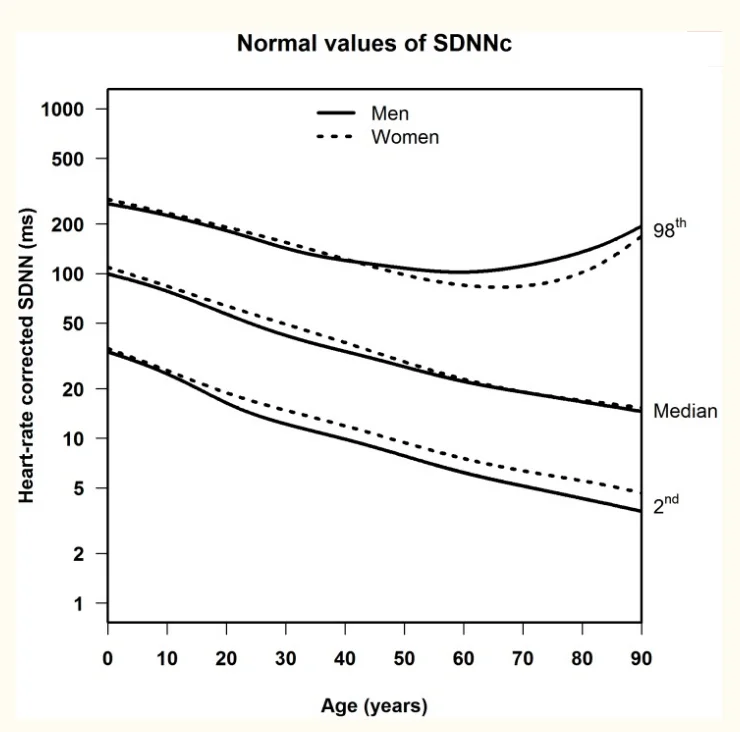
HRV tends to decline as we age, and there's a considerable range of "normal" at every age. The chart above, drawn from population-level research [2], shows this clearly.
Your HRV also fluctuates throughout the day. How recently you exercised, how well you slept, what you ate, and how stressed you feel can all shift it in the short term. That's why looking at trends over weeks and months is far more useful than any single reading. A bad night's sleep will dip your HRV tomorrow; that doesn't mean something is wrong.
Generally speaking, within the normal range for your age, higher is better. And the good news is that HRV responds to the things you do -- it's not fixed.
How to improve your HRV
Because HRV reflects the overall state of your autonomic nervous system, the ways to improve it are the things that support your nervous system in general:
Regular exercise. Consistent, moderate exercise is one of the strongest drivers of improved HRV over time. Overtraining can temporarily lower it, so balance matters.
Good sleep. Both sleep quality and consistency matter. Going to bed and waking up at roughly the same time helps your nervous system settle into a rhythm.
Stress management. Chronic, unresolved stress keeps the sympathetic branch dominant. Anything that genuinely helps you unwind -- whether that's walking, reading, breathing exercises, or time outdoors -- supports the parasympathetic side.
Breathing practices. Slow, controlled breathing -- particularly with a longer exhale than inhale -- directly activates the vagus nerve and can shift your HRV in real time. This is one of the few interventions where you can see an immediate effect.
Diet and hydration. A balanced diet and staying well hydrated support the basic physiology that HRV depends on. There are no shortcuts here, but the fundamentals matter.
The vagus nerve connection
The vagus nerve is directly connected to your heart and is the primary carrier of parasympathetic signals. A well-functioning vagus nerve -- sometimes described as having good "vagal tone" -- is closely linked to higher HRV. Strengthening vagal tone through breathing practices, cold exposure, and vagus nerve stimulation is one of the most direct ways to support your HRV over time.
Even if you use stimulation to support vagal tone, combining it with the lifestyle fundamentals above will give you the best results. HRV responds to the whole picture, not any single intervention.
Join our HRV study
We're currently running a study measuring HRV in real time during tVNS sessions -- with real customers, in their own homes. If you own a Bluetooth chest strap heart rate monitor and one of our devices, we'd love you to take part.
Find out more and enroll here.
References
[1] Young, Hayley A, and David Benton. "Heart-rate variability: a biomarker to study the influence of nutrition on physiological and psychological health?" Behavioral Pharmacology vol. 29, 2 and 3-Spec Issue (2018): 140-151.
[2] van den Berg, Marten E et al. "Normal Values of Corrected Heart-Rate Variability in 10-Second Electrocardiograms for All Ages." Frontiers in Physiology vol. 9 424. 27 Apr. 2018.
[3] Hayano, J., Yuda, E. Pitfalls of assessment of autonomic function by heart rate variability. J Physiol Anthropol 38, 3 (2019).
[4] Shaffer, Fred, and J P Ginsberg. "An Overview of Heart Rate Variability Metrics and Norms." Frontiers in Public Health vol. 5 258. 28 Sep. 2017.
[5] Ernst, Gernot. "Heart-Rate Variability -- More than Heart Beats?" Frontiers in Public Health vol. 5 240. 11 Sep. 2017.