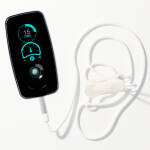
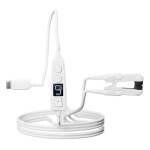
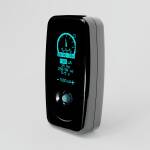


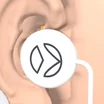

tVNS Research Edition
A modular research platform with full parameter control, validated sham mode, four waveform types, and three ways to control your device. Start with a Vagal Buddy, unlock research capabilities with a firmware upgrade.
- Current-controlled output (EverSteady)
- Bluetooth Low Energy connectivity
- Three ear clip sizes included
- CE marked, FCC certified
- IEC 60601-1 compliant
- 0.1–100 Hz frequency, 0–4 mA amplitude
- Sham mode for double-blind studies
- Four waveform modes
- Chrome Control Surface
- MCP device control via Claude
Transcutaneous vagus nerve stimulation research requires precise, reproducible stimulation parameters. Consumer devices are designed for ease of use, not for the needs of controlled research environments. They often lack parameter transparency, sham capability, and data export, all essential for publishable, defensible results.
The Research Edition uses current-controlled stimulation, which means the delivered dose remains constant regardless of changing electrode impedance, skin moisture, or session duration. If you set 1.0 mA, every subject receives 1.0 mA, every session. Voltage-controlled consumer devices cannot make this guarantee because the actual current fluctuates with skin conditions.
A built-in sham mode delivers a brief initial sensation that fades to zero stimulation, enabling proper double-blind study designs without the earlobe-placement workarounds that compromise blinding in many published protocols. Both participants and administrators can be blinded.
Session data logging captures delivered parameters, timing, and impedance throughout each session. Data exports to MATLAB, R, Python, and SPSS. Real-time impedance monitoring flags electrode contact issues before they compromise your data.
| Frequency Range | 0.1 – 100 Hz (±0.1 Hz resolution) |
| Current Range | 100 – 4,000 μA (±0.1 mA precision) |
| Phase Duration | 15 – 1,000 μs |
| Interphase Gap | 15 – 1,000 μs |
| Output Control | Current-controlled (EverSteady technology) |
| Waveforms | Symmetric, Alternating, Asymmetric, Monophasic |
| Session Duration | 1 – 60 minutes |
| Duty Cycle | 0 – 300s on/off configurable |
| Anti-Habituation | 0 – 99% frequency variation |
| Session Logging | Up to 8 hours continuous |
| Connectivity | BLE + Web Bluetooth + MCP |
| Ear Placement | Left or right tragus (three clip sizes) |
| Safety Standards | IEC 60601-1, ISO 13485 |
| Regulatory | CE Marked, FCC Certified |
Research FAQ
How long does the battery last on the Research Edition?
Do you offer institutional purchasing or volume discounts for labs?
What is the Research Edition and how does it differ from the standard Vagal Buddy?
Does it hurt? What do subjects report about the sensation?
How does the sham mode work for double-blind studies?
Can I get IRB or ethics board documentation for my study proposal?
What data formats does the session logging export?
Can subjects use the device at home for longitudinal studies?
Research-grade vagus nerve stimulation equipment with full parameter control, sham mode, data logging, and BLE connectivity. Purpose-built for clinical studies and neuromodulation research.