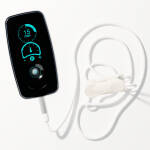




Every Tone we have made so far has been our protocol. We chose the frequency, the pulse and the rhythm, and you chose when to use it. Bespoke Tone, available since the end of July, turns that around. You set every stimulation parameter yourself, from a paper, from a clinician, or from what you have learned works for you, and it is written to your device exactly as entered.
It is built for people working to a protocol. If that is you, here is what you can set and why each setting matters.
Frequency, from 1 to 100 Hz
Frequency is how many pulses reach the nerve each second, and it is the setting a protocol is most likely to specify. As a rough guide:
- 1 to 10 Hz feels more like a slow tap than a buzz, and suits people who find stimulation sharp. Gentle Rhythms runs at 8 Hz and Recover at 10.
- 20 to 30 Hz is where most published auricular protocols sit, 25 Hz most of all. So do our Nightshift, Balance, Calm and Uplift.
- 50 to 100 Hz smooths out into something more continuous. Digestion uses 75 Hz.
The hardware can go higher, and Research Edition exposes the full range. Bespoke stops at 100 Hz because published transcutaneous auricular protocols essentially all sit below it, and because frequency and pulse width compete for room inside each cycle.
The shape of each pulse
This is where Bespoke goes further than My Tone, which only let you pick a frequency.
- Phase, or pulse width: 50 to 1,000 microseconds. How long each half of the pulse lasts. A wider pulse delivers more charge, so at the same current it feels stronger. If stimulation is uncomfortable at the current you need, narrowing the pulse is often a better move than turning the current down. Our own Tones range from 100 microseconds on Nightshift to 500 on Uplift, which is a big part of why those two feel so different.
- Interphase interval: 50 to 500 microseconds. The pause between the positive and negative halves of each pulse. Every Vagal protocol ships at 100.
A pulse has to fit inside its own cycle, so the configurator does the arithmetic on every change. At 25 Hz a cycle is 40,000 microseconds long and almost anything fits. At 100 Hz it is 10,000. If a combination will not fit, the configurator says so plainly and will not let you buy it, so you find out before you order rather than on your ear.
Four waveform modes
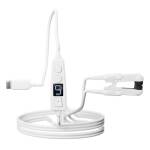
Until this year every Tone we sold was symmetric biphasic, because that was the only shape the hardware exposed. Vagal Buddy and Vagal Oh! now expose four, and Bespoke is the first product where you choose.
- Symmetric biphasic. Equal and opposite halves, so the charge going in balances the charge coming out. The safe default, and it works on every device we have shipped.
- Alternating (Buddy and Oh!). Still balanced, but the leading polarity flips on every pulse. Usually described as slightly less pointed than symmetric at the same settings.
- Asymmetric (Buddy and Oh!). A short, tall phase followed by a long, shallow one. Charge still balances, with the peak concentrated at the start.
- Monophasic (Buddy and Oh!). One direction only. It is common in older literature, so you may need it to reproduce a published protocol, but it is not charge balanced, and that is exactly why biphasic became the standard. Choose it deliberately, for a reason, and prefer shorter sessions.
The original tVNS Stimulator has no waveform control. When a Bespoke Tone loads, the device is asked what it actually supports. If it cannot deliver the waveform you chose, the load is refused and tells you why, rather than quietly substituting symmetric biphasic and calling it done.
On and off cycles, and session length
A continuous session runs from start to finish without pausing. A duty-cycled session stimulates for a while, rests for a while, and repeats. Nerves adapt to unchanging input, so a pause keeps the next burst meaningful, and many people simply find a rest every minute easier to sit through. Calm uses 60 seconds on and 60 off. Uplift uses 60 on and 30 off.
Bespoke gives you two free number fields. The device has one rule: on and off are either both zero, for a continuous session, or both at least five seconds. Following a paper that cycles 7 seconds on and 13 off? Enter exactly that.
Session length is set separately, to the second, from one minute to an hour, or continuous with no scheduled end. A 22.5-minute protocol is entered as 1,350 seconds rather than rounded.
Name it, load it, share it
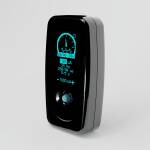
Give your Tone a two-line name of up to ten characters per line and it shows on your device's screen, along with the spec, so you can confirm that what loaded is what you configured. It is delivered straight to your Vagal Tones app, it is a one-time purchase with no subscription, and it is yours to keep.
Every configuration also has a Tone Code. Send it to a clinician, a colleague or a study participant and they can open the configurator with your exact settings.
Who it is for
Bespoke is for people working to a protocol: your own, your clinician's, or a published one. If you would rather not think in microseconds, our ready-made Tones are still the easier place to start.
Bespoke Tone writes exactly the settings you enter, so choose them with care. It is not medical advice, and if a clinician has recommended settings for you, those come first. Questions about a protocol? Get in touch.